The thing is, Gaston is not dumb.
I mean, yes, absolutely he is, but not in the way people usually mean when they say it.
He is not unintelligent. He speaks articulately. He knows words with more syllables than strictly necessary. He drops expectorate into casual conversation like a man who once skimmed a book and decided that was enough reading for a lifetime. He understands people well enough to work a room, collect admiration, and remain extremely confident in the belief that he is a main character in everyone else’s book of life. None of that happens by accident.
His problem is not that his brain does not function. It is that his ego has seized the steering wheel, locked the doors, and thrown the map out the window. Everything he encounters gets filtered through a single question. Does this affirm my greatness or does it need to be eliminated. Belle, incomprehensibly, does neither.
Watching Beauty and the Beast on stage the other night, it finally clicked for me that this is not really a story about a brute and a prince, or even about love in the way we are usually pushed to talk about it…nope, not really. It is actually a story about ego management. One man’s ego runs unchecked, applauded by a town that mistakes confidence for character. The other starts off just as ruled by his ego, only his comes with consequences. Walls. Claws. Furniture that judges him…I bet that last part wasn’t on his bingo card.
It is also probably worth pausing here to name the part of this story we tend to politely step around. The Beast captures Belle. Period. Not metaphorically. Not emotionally. Like…literally. Locks her in a castle. Removes all exits. And then, with what appears to be sincere hopefulness, waits to see if she might eventually fall in love with him. Which is… certainly a choice one can…make…. but a deeply, deeply, questionable one.
Belle, who has already been established as stubbornly independent, intellectually restless, and profoundly uninterested in being managed by men, only begins to soften once every other option has been taken off the table. No village. No wandering. No alternatives. Just a temperamental host with anger issues, a tragic backstory, and a dining room full of enchanted witnesses rooting for Stockholm Syndrome to really pull through.
From a psychological standpoint, this ain’t a great look. Growth that happens after captivity is not the same thing as growth freely chosen. Affection that develops under surveillance deserves a raised eyebrow at minimum. The fact that we dress this up with musical numbers and sentient teacups does not magically turn coercion into romance.
But I di-greg.
What separates Gaston and the Beast is not kindness versus cruelty. They both start out plenty cruel. It is not strength, intelligence, or even moral intent. The difference is whether their ego is ever meaningfully interrupted.
Gaston’s ego is constantly fed. The town mirrors him back to himself like some bonkers funhouse designed by sycophantic yes-men….yes-women, too. yes-folk? He is strong because everyone says he is strong. He is admirable because no one seriously challenges the idea. Even his violence gets reframed as protection. There is never a moment where Gaston is forced to sit with himself without an audience applauding. As a result, he never develops the ability to self-correct. His ego is not only firmly intact. It is constantly reinforced.
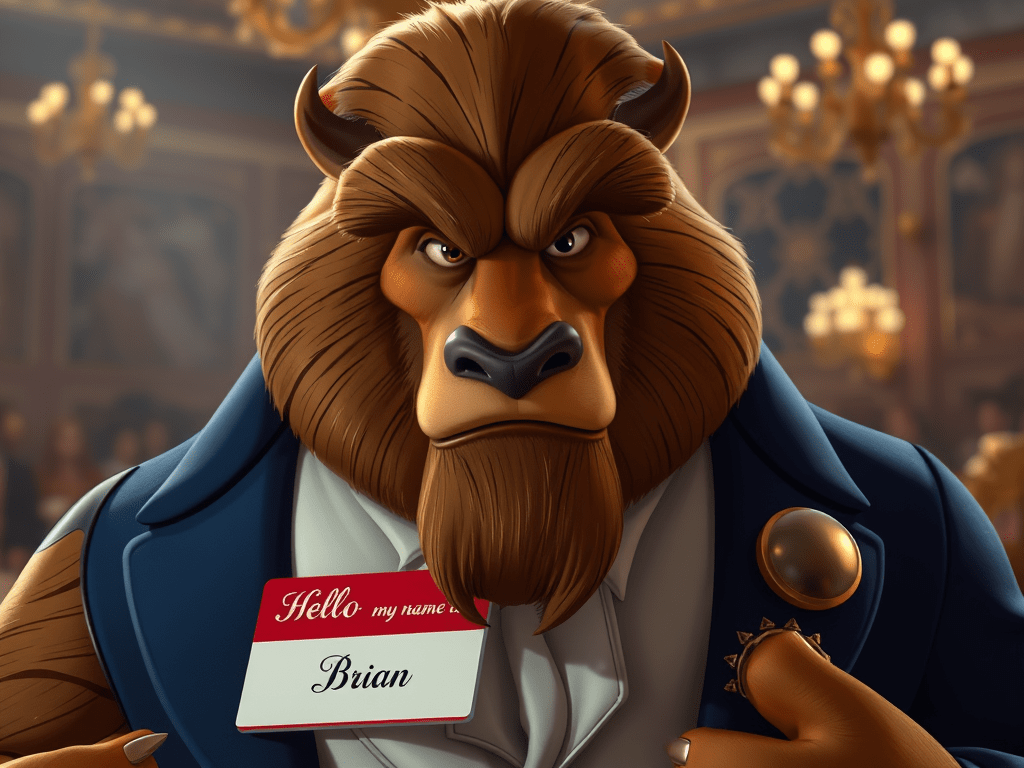
The Beast (Brian. That’s his name now. I mean, know one can tell me a different name so I shall make my owe for him), on the other hand, lives inside the consequences of his own ego. His isolation is not accidental. It is the natural outcome of years spent reacting rather than reflecting. But unlike Gaston, he does not get to externalize blame to indefinite and unreasonable degrees. There is no crowd to cheer him back into comfort. The walls stay up. The curse stays put and his temper costs him something just a bit more each and every time it surfaces.
Now this is where the story quietly shifts. Not because Belle fixes him, despite the romantic yet horrifying narrative that the world quietly told little girls for the last 30ish years, but because he is finally forced to experience life without the buffer of admiration. His ego stops working the way it always has. It no longer protects him. It only keeps him alone with just his thoughts, a horny candlestick, and a shit-talking clock.
As I see it, Belle is the stress test in all of this. Not the prize. Not the healer. She is the point where both men are revealed for who they are. Gaston cannot tolerate her refusal because it contradicts his sense of self. Her “no” is not information. It is malfunction. Something must be corrected. Persuasion turns into pressure. Pressure turns into punishment. When that fails, he reaches for narrative control and recruits the town to help him rewrite the story.
The Beast, ehem Brian, responds differently, though not in my opinion cleanly or heroically. He controls the environment instead. He limits exits. He mistakes proximity for intimacy and restraint for safety. To his credit, this eventually becomes unbearable to him. To the story’s credit, it at least gestures toward the idea that this is a problem. Still, Belle’s freedom and her definition of self remains the collateral damage while he figures himself out. Take your time, Brian. We’ll just put the damsel’s humanity on hold and give you the time the you need…sigh…
And this is the uncomfortable hinge of the whole narrative. Brian’s growth does not begin with love. It begins with limitation. With silence. With having nowhere to redirect his rage except back at himself. Gaston never reaches that point. He never has to. His ego is never deprived long enough for it to starve.
Which brings us to why this story sticks….somehow.
What lingers for me is not the romance. It is the tension we never quite resolve. We want the story to be about love changing someone, because that feels hopeful and neat. What it is actually about is power being interrupted, and how rare that interruption really is.
We are remarkably generous with characters who show growth, even when that growth comes after harm. Don’t eve get me started on that demi-god from Moana, you’re welcome. We watch as sharp edges soften. We hum along. We tell ourselves that improvement redeems the process. And it is absolutely true that sometimes it does, at least partially. But that generosity has a cost. It trains us to overlook damage, especially when the person who caused it looks sad enough afterward. I am still judging you, Maui.
Gaston is easier to reject because he never apologizes. He never doubts. He never stops believing the world owes him something. The Beast, BRIAN – I am speaking this into existence, is harder, because he learns..and because it seems like he regrets. But perhaps more importantly because it puts in effort; because he tries. And because of all of that, we are tempted to retroactively excuse the cage, the temper, the fear, the imbalance of power that made growth possible in the first place.
Belle ends the story loved, but she also ends it having endured. That part rarely gets airtime. Her captivity is framed as necessary for transformation, which is a deeply unsettling idea once you sit with it. The implication is not just that change is possible through love, but that it may, on occasion, require someone else to stay trapped long enough for it to happen.
As long as I am going down this rabbit hole, I feel like e should take a moment to acknowledge that this is where the fairy tale stops being harmless.
Outside the castle, we repeat this logic constantly. We excuse volatility if it comes with vulnerability. We excuse control if it comes with eventual self-awareness. We praise men for learning not to harm as though that lesson itself should count as virtue. Gaston is what entitlement looks like when it is never challenged. The Beast, I’m being judgy so I’ll call him Beast this time, is what entitlement looks like when it finally runs out of room.
The distinction is significant and it just does not erase the damage.
But I di-greg.
Fairy tales are not instructions. They are mirrors. This one reflects how easily we confuse growth with absolution, how quickly we minimize captivity when the captor feels bad enough, and how often women’s endurance gets reframed as love.
Which is not nothing for a story with dancing plates, talking clocks, and a candlestick who definitely a real specific set of intentions with a feather duster…

 Notes in the Margins
Leave a comment